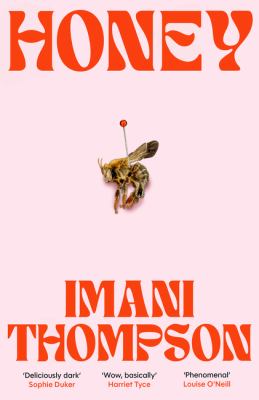
Honey is a provocative novel by Imani Thompson, a British author of Scottish, Irish and Jamaican heritage. Described by British Vogue as “the UK’s most hyped thriller”, the story follows beautiful and smart Yrsa, who is experiencing a sort of “writer’s block” in her PhD research on Afro-pessimism.
Scholars see Afro-pessimism as a way to observe how the ongoing effects of “racism, colonialism and historical processes of enslavement” have been impacting the Black people in every aspect of their lives. The view is indeed pessimistic, seeing even today’s civil society as being dependent on “anti-Black violence”.
Yrsa – whose name is of Old Norse origin and means “she-bear” or “fury” – is sick and tired of those self-entitled and hypocritical men in her life. When she discovers a professor has not only manipulated her best friend but also stolen the latter’s research, she takes action – which leads to that professor’s death by bee allergy.
Somehow the incident awakens something in Yrsa – a sense of thrilling control, a sweet and even sexy feeling of being able to take justice into her own hands. Increasingly emboldened, she decides to take on those sexist, misogynistic and abusive men that she thinks are aplenty both online and in everyday society.
As Yrsa becomes more unhinged, trying to justify her “violence against violence” approach as a new “theory/methodology in action” that fulfils feminist and racial justice, her life sinks further into chaos. The character’s struggle to intellectualise her action is precisely the reason why she slowly but surely drifts towards the immoral path, forgoing precious opportunities to find love and hope and edging towards self-destruction and despair.
Yrsa is certainly not a likeable character. However, this story is not about badass women fighting and punishing bad men. Nor is it an endeavour to psychologically profile the rise and fall of a serial killer, investigating their past trauma and probing the dark corners of their mind to elicit sympathy and even forgiveness.
Instead, to this reviewer, Yrsa’s story is a diligent and occasionally tedious exploration of Afro-pessimism. By portraying the character’s intersectional experience as a Black person in a white people’s world, as a Black woman in a white man’s world, as a Black woman in a white woman’s world, and as a Black woman in a Black man’s world – the story is an ambitious attempt to illustrate the complex and layered power dynamics, stereotypes and patriarchy that Black women (and women of colour in general?) have to endure.
In this sense, Yrsa’s boredom can be interpreted as having derived from a profound sense of helplessness and hopelessness in her pathetic and futile resistance against the oppressive system. Having tried all she can but still failing to find way out – because there is no exit at all – her world can only implode. The story’s abrupt and ambiguous ending is therefore understandable.
Highly recommended.
Note: This book review was originally titled “A provocative debut novel” and published under the title “Verdict: provocative debut novel” by Ranges Trader Star Mail, February 19, 2026, P.17.