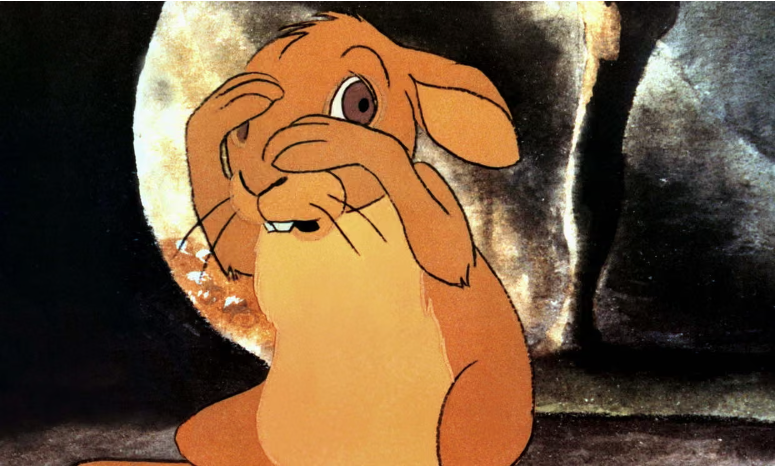
Following yesterday’s post, in my attempt to understand Melanie Cheng’s The Burrow, I read about the book Watership Down (1972) by English author Richard Adams.
I am a rabbit lover, but there seems to be too many rabbits in this book. It reminds me of Erin Hunter’s Warrior series about cats, not to mention their Survivors series about dogs, Bravelands series about African animals, and Bamboo Kingdom about dragons.
Anyway, it is a delight to find that in Watership Down, the rabbits have their own folklore and mythical characters, including deities of various rankings, heroes and anti-heroes. A great example is the Black Rabbit of Inlé, “a sombre phantom servant of the god Frith who appears in rabbit folklore as a kind of analogue to the grime reaper…[whose] duty is to ensure all rabbits die at their predestined time, and he avenges any rabbit killed without his consent”. Awesome.
Also great to know that Adams invented the rabbit language Lapine, like J.R.R. Tolkien invented Sindarin for the Elves or Marc Okrand invented the Klingon language for Star Trek. But, compared to the latter two, Lapine is quite simple, “somehow easy to accept as [a language] we have always known,” says Wikipedia. “It is the language of the countryside, of its copses and beeches and of the weather.”
I love it that the cardinal numbers in the rabbit language “only go up to four, with any number above that being called hrair”, which means “many”. Considering the runt rabbit character Hrairoo’s name is translated into English as “Fiver”, it may be a clue that helps me understand the role the pet rabbit plays in Cheng’s book.
(Image credit: “Watership Down: the film that frightened me the most” by Phil Hoad via The Guardian, which reminds me of Steven Spielberg’s reflection on the 1942 animated film Bambi. Explains Hoad: “The perfect point to be most affected by the subtlest of all horror sensations: the child’s belief that whatever you see is real. Adults hold that feeling at bay with laws that mark off the boundaries between fiction and reality, most porous when it comes to filmed images… The child doesn’t make those distinctions, of course. And we’re children again when we watch, not so much suspending disbelief as resuming belief. Watch the right (or the wrong) things, and it will change you for ever.”)
(Day 65 #WarmWinterRead #WWR25 via @librarieschangelives)
 Voices under the Sun 陽光下的聲音