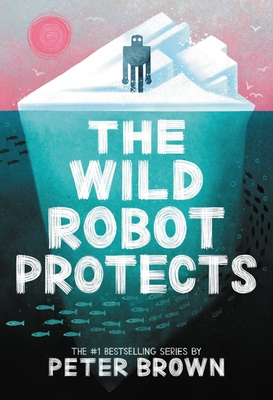
After the conclusion of his bestselling duology – The Wild Robot (2016) and The Wild Robot Escapes (2018) – American author and illustrator Peter Brown decided to explore other fascinating subjects through his intriguing character Roz.
The author explained in The Wild Robot Protects (2023) that the most important theme in the previous Wild Robot books is the idea of home. “When I started working on this third book, I knew only that it would involve Roz protecting her home. But protect it from what? Humans? Other robots? Something else entirely?”
Considering the effects of climate change are becoming increasingly frequent, intense and widespread in recent years, there is no surprise that Brown shifted his attention to human-caused environmental issues. He decided to have Roz go to “extraordinary lengths” to protect her home from a mysterious form of pollution known as the poison tide.
Perhaps the author tried too hard to cram too many things into a relatively small book. “Real life is complicated, and this story needed to reflect that truth.” Not only are there a new cast of animal characters in the water, on land and in the air, but the myriad ways in which they struggle to survive in their rapidly changing environments also need to be adequately presented.
Meanwhile, there are new settings and unfamiliar technological challenges that Roz needs to tackle, and these need to be scientifically clear and convincing. Above all: “I wanted to have readers care deeply about everything that was happening, and to do that the story had to be believable. There could be no easy solutions and no clear villains.”
Suffice to say, by the time Brown has all these difficult and complex tasks sorted out near the end of the book, the story becomes lighter and the writing more relaxed. It is great fun finally finding the source of the pollution and observing how Roz methodically handles a seemingly unsolvable problem. Even more fascinating is seeing how the robot discovers her new capacities while holding on to those principles and values that make her so endearingly “human”.
Indeed, it is quite easy to imagine the last third of the book being adapted into another visually dazzling animated film, with Roz confronting some massively daunting obstacles. Luckily, as in the two previous books, the robot is never alone and works well with her animal and human friends. The story’s ending is particularly satisfying and heart-warming.
Finally, it is worth noting that Brown did an excellent job illustrating this book, which is another reason why readers can easily imagine the making of a wonderful movie based on Roz’s wild and courageous adventure. There are a couple of “hero shots”, but, as usual, the most heart- warming images are of the robot and her family on the island, perfectly relaxed at their beloved home.
Note: This book review was originally titled “A thrilling, action-packed adventure”.
 Voices under the Sun 陽光下的聲音