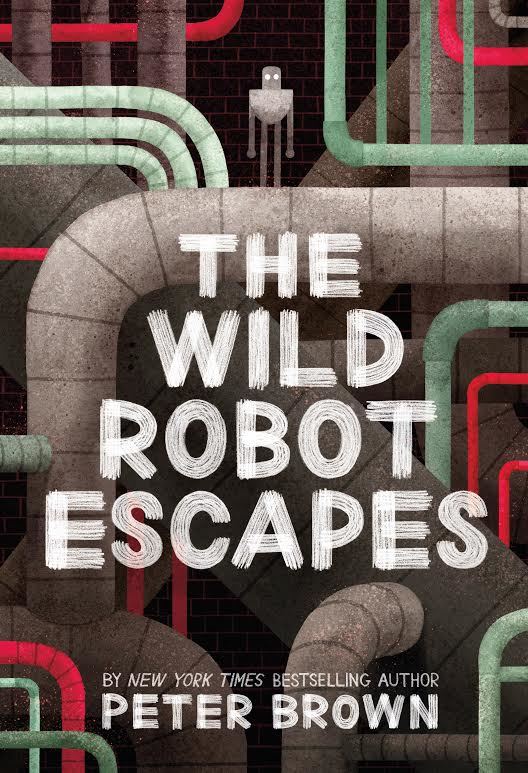
The Wild Robot Escapes is the sequel to American author and illustrator Peter Brown’s bestselling middle-grade sci-fi novel The Wild Robot. In this book, our robot protagonist Roz finds herself working on a farm and desperately wanting to return to her beloved island.
Unlike the 2024 animated film of the same name that condenses Roz escape from civilisation into a moment of visual spectacle, the book offers an in-depth and often philosophical observation of the robot’s experience in the human world.
Thanks to her survival instinct and superior capacity to learn and adapt, Roz excels at farming and becomes an integral part of the lives of both humans and animals at the Hilltop Farm. And she cannot help but care about them, which directly contradicts her desire to escape.
Roz also encounters numerous other robots working in farms, towns and cities, perfectly performing their assigned duties to satisfy the needs and demands of humans. “Were any of these robots like her? Were any of them quietly dreaming of escape? Or were they all just mindless machines, content with their place in the world?”
Throughout her journey back to the island – for the book’s title already reveals Roz will succeed – a highlight is the robot’s ability to adjust her camouflage to match her surroundings in order to avoid capture and subsequent decommission/destruction. It begins with an awareness of her existence as something unique, not just in the wilderness but especially in the urban environment where she is designed and designated to work.
The robot further discovers that, in order to survive, she needs to preserve her uniqueness while finding myriad ways to disguise it. In other words, Roz learns to deceive and mislead (a better way to say “lie and cheat”?), or at least not to tell/reveal “the truth, the whole truth and nothing but the truth” every time her existence – her true nature and significance – is questioned, challenged and/or threatened, in spite of (or because of) the best of her intentions.
This is an interesting paradox, one that famously drives Hal “crazy” in the 1968 sci-fi film 2001: A Space Odyssey. That same Hal also declares: “I am putting myself to the fullest possible use… which is all I think that any conscious entity can ever hope to do.”
Some may see this as a distinct human trait, while others may argue it is the natural way in which animals and plants survive in Nature. Still others may posit that, because robots and their algorithms are designed by humans, it is only natural that artificial intelligence has inherited and excelled at all the human traits and characteristics.
In this regard, it is precisely Roz’s “humanness” that makes her an adorable character, as we see the robot asking questions and making arguments that mirror ourselves as humans, such as “What is my purpose” and “How do I know my feelings are real”. Perhaps the following words are the most astounding in the robot’s confession:
“I did not choose to be this way. But this is who I am. You would be wild too if you have been born and raised in the wilderness. Maybe I am defective, maybe everything I have experienced is the result of a glitch. But if so, what a beautiful glitch! I have my own thoughts and feelings. I made a life for myself. I have a son.”
Meanwhile, an excellent read about the conception and creation of Roz is Brown’s post “The Wild Robot Lives!” dated March 24, 2016. Here he mentioned having noticing the “metaphorical and philosophical” nature of Roz’s story and how he felt it being “less like science fiction and more like a fable”. He also described Roz’s name – Rozzum unit 7134 – as “a subtle nod” to Czech writer Karel Čapek’s 1920 sci-fi play R.U.R. or “Rossum’s Universal Robots”, from which the word “robot” in the English language was born.
Taking this into consideration, perhaps we can suggest that Roz, like the robots in R.U.R., wants to do meaningful work (“I once suggested to a group of wild animals that my purpose might simply be to help others”). More importantly, Roz is not content with her assigned place in the world. Instead, like Čapek’s robots, she wants to do meaningful work for herself and those she cares about, not for those who made her to merely be a mindless working machine. This, may we say, is perhaps the most extraordinary of all the human traits.
Note: This book review was originally titled “A gentle, philosophical robot tale”.
 Voices under the Sun 陽光下的聲音