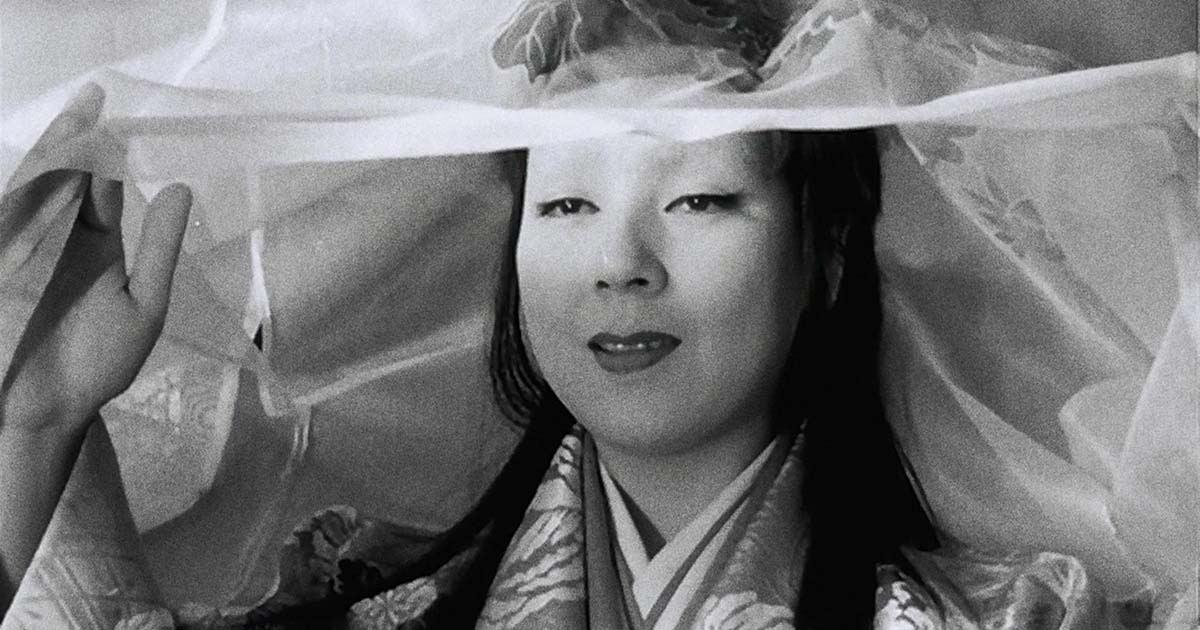
Reading this week’s cinema sessions at ACMI (Australian Centre for the Moving Image) and saw the renowned Japanese film Ugetsu (1953). It is part of the centre’s “Spotlight on Japanese Horror” series that recently piqued my interest.
“Ugetsu”, meaning “rain and moon”, is adapted from Japanese author Ueda Akinari’s 1776 book Ugetsu Monogatari or “Tales of Moonlight and Rain”. It is fascinating that the book is an “adapted novel” or “hon’an shosetsu”, the genre popular in the 18th century where translations of Chinese stories were adapted to fit into Japanese culture and historical settings. Even more surprising is the fact that Akinari drew inspiration not only from the original Chinese stories, but also from other existing Japanese adaptations of them.
“This was not viewed as plagiarism, as ‘the notion of the artist prevalent in [his] time defined [literary] practice as one involving an adaptation of the tradition,” explains Wikipedia. Akinari’s writing was even praised for its “unique take on the existing stories”, as he reinterpreted them “as historical tales set in Japan, weaving together elements of the source stories with a rich array of references to historical events, personages, and literary works, as well as Japanese folklore and religion”.
I wonder, what would it take for an adaptation of an original work to become a different kind of original in its own right?
(Note to self: Found two different English translations of The Tales of Moonlight and Rain. One is by Anthony Chambers for Columbia University Press in 2008, and the other is Routledge’s 2012 reissue of Leon Zolbrod’s 1974 translation. It is interesting how Zolbrod, “a pioneer scholar of traditional Japanese literature” as described by the University of British Columbia in Vancouver, developed his scholarly interest “from his duties as a member of the U.S. Army of occupation in 1948”.)
(Day 49 #WarmWinterRead #WWR25 via @librarieschangelives)
 Voices under the Sun 陽光下的聲音