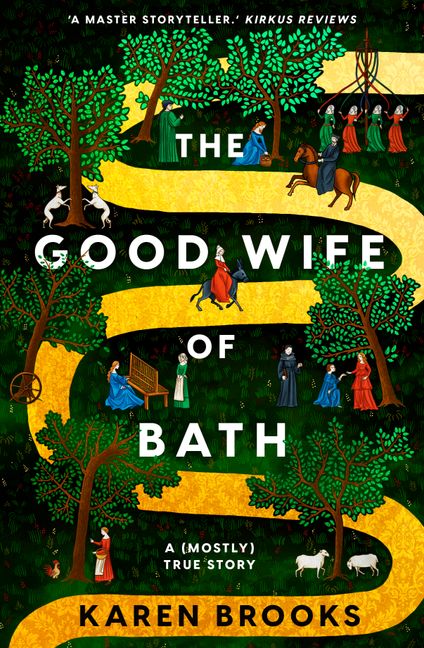
The Good Wife of Bath is the 15th book by Australian author and academic Karen Brooks. Like her previous works of historical fiction, it is a result of meticulous research and vivid, empathetic imagination about a fictitious woman’s life – and in this case, a life imagined by a medieval man.
The book’s source material is the Wife of Bath’s Prologue and Tale from English poet Geoffrey Chaucer’s The Canterbury Tales. While Chaucer appeared to be mocking the Wife – a woman who fiercely opposes the social belief of her times in the inherent inferiority of women – Brooks gives her a voice so that she can tell her own story.
And what a brilliant and riveting story it is. Having been married off to an elderly farmer at the age of 12, the first-person narrator Eleanor struggles to establish herself as a woman with “a good head for business” and a mind of her own.
More importantly, all her life – through “five marriages, several pilgrimages, many lovers, violence, mayhem and wildly divergent fortunes” as summarised by the book blurb – Eleanor fights for her right to make her own choices and take control of her fate.
This does not mean she is without flaws or failures. Quite the opposite, this is a feisty woman who has made many terrible mistakes and paid mighty prices for them. But she is also honest and loyal, determined to do anything within her power to protect those she loves.
At one stage, one of Eleanor’s friends says about her: “[You think] she doesn’t know what it’s like to yearn, to hope, to bleed? To be poor? To cry and wish to God in Heaven things were different? She’s been through more than you can imagine and, guess what? It’s never stopped her trying, nor giving folk a chance. She never says anything she doesn’t mean and she certainly wouldn’t be making offers if they weren’t genuine.”
In other words, Eleanor is just a descent person, and despite all her flaws and quirks – and her “sins” in the eyes of those (men) of her times – her demand of being treated as an equal to those (men) who seek to control her never ceases. It is her unwavering pursuit of independence that makes her an extraordinary character.
Like the Wife in Chaucer’s writing, Eleanor is “assertive” and even “nasty” in her defiance of conventional (and traditionally male-dominated) views about the role and rights of women, both within and outside of marriage. Even to today’s readers, her rants make sense: “I wanted authority, aye, but not over my husbands. That made me no better than them. What I really wanted, what I’d learned through experience, was authority over myself. I wanted respect.”
And, perhaps echoing fellow Australian author Jess Hill’s 2020 Stella Prize-winning book See What You Made Me Do: Power, Control and Domestic Abuse, Brooks has Eleanor saying this to those men who continue to make women pay for their mistakes, claiming it is Eve who is responsible for the Fall of mankind: “Eve didn’t make him eat the bloody fruit. She offered Adam a choice and he made one.”
In her “Author’s Note”, Brooks points out that Eleanor is subject to the “social, economic, sexual, gendered, cultural and political forces of [her] day”, and these forces may or may not be quite different from those of our own times. One thing is for sure – what remains unchanged today is that women have lived and their voices and choices have influenced what we are now told as history, and will continue to do so. These voices and choices deserve our respect.
Note: This book review was originally titled “Herstory happened too”.
 Voices under the Sun 陽光下的聲音