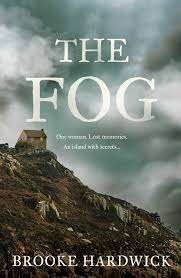
The Fog, by Australia-born and currently Netherlands-based author Brooke Hardwick, is set in Rathlin Island, the northernmost point of Northern Ireland. On this wild, remote land, an unconventional retreat at a cliffside mansion promises to unlock writers’s block in ten days. The story’s first-person narrator Kate arrives, hoping to uncover the secrets of her past so she can finish her novel.
Kate’s husband disappeared after the tragic loss of their daughter, but she has no idea where or why. The bits and pieces of memories plaguing her draw forth more questions than answers, so the unorthodox therapy offered at the retreat appears to be her only hope, with the unusual techniques tapping into the island’s mythical past and helping to unravel repressed trauma.
However, as Kate’s flashbacks become increasingly intense and disturbing, she realises what she remembers as her life is not true, and her husband has never been who she thinks he is. Her real past is much darker and scary, but there are also dangers lurking on the island. It seems that no one can be trusted, not even her fellow attendees at the writer’s retreat.
It is hard to critique The Fog without spoilers, as the whole book is about revelation. Suffice to say, the story highlights some of the most urgent and alarming issues in our society, whose origins can be traced back to the fundamentals of power and control. Not just between partners in a relationship, but also between members of the same family.
Traumatised by her past, Kate desperately wants to get back the memories of those shocking events that she experienced and witnessed, which she hopes will help her heal. Yet, from the reader’s perspective, the use of first-person narration may not be ideal. For example, throughout the story, we not only observe Kate’s flashbacks, but also have to follow along as she summarises and analyses everything and uses them to deconstruct her existing memories. That is a lot of duplicated material to be endured, not to mention her detailed deciphering of what is valid and why.
Furthermore, as much as we can sympathise with what Kate is going through emotionally and psychologically, her character is inconsistent due to her repeated questioning and doubting herself. For sure, in her existing memories and at the start of the ten-day period, this is a timid, feeble, submissive, insecure, frequently flustered and perpetually self-undermining character that is bordering pitiful and unlikeable.
In sharp contrast, as Kate salvages more memories of her past, she seems to turn into a different person. This Kate – in some of the flashbacks and particularly at the end of the ten-day period – is clear-headed, organised, adequate at planning ahead and willing to take risks while calculating and preparing for the potential consequences. To say it is hard to reconcile these two dramatically different versions of the character is an understatement.
Some may argue the “weak Kate” is the result of what was done to her in the past, and the trauma of losing her daughter is the final straw that broke her mind with amnesia. That certainly is the point about power and control in relationships, with one being oppressed to such an extent that either she implodes, her mind crushed beyond repair by that relentless, suffocating pressure, or all her repressed emotions finally unleash in torrents, hence the “strong Kate”.
However, in the book, Kate’s amnesia is only partial, with all those memories of the truth conveniently tucked away and needing retrieval, while her existing memories illustrating a seemingly perfect life. Similarly, the contrast between the two versions of the character is so necessarily staggering that the “weak Kate” seems ridiculously minuscule and inept. Indeed, when the “strong Kate” asks herself why she let it all happen – “Why hadn’t I resisted? I was proud and strong, I had my own life – my own dreams – I was on the cusp of my future – a new identity” – it appears to be the very first time Kate ever truly looks at herself, with the subject of her survey being a woman lacking agency and requiring intervention. Worse, to comprehend it all, she has to read the woman’s journal where all her flashbacks have been recorded and scrutinised.
It is through this female gaze that our heroine is finally able to diagnose and treat her subject’s problem: “There’s a rush of blood through my veins. My throat tightens, and then every memory and truth collides in my head. An almighty howl leaves my mouth, penetrates the wind and echoes along the cliffs. It’s huge and piercing and filled with all my pain. I have my voice back. I can scream.” She conceals her corresponding action afterwards: “It’s not a burden, this secret. It’s the truth, and it reminds me who I am – a woman who found her courage.” Then she moves on to a new project: “It’s a story about a woman in a bad relationship – a strong woman who frees herself from constraint and control and survives.”
So the female gaze continues, and our protagonist is always watching and examining herself as a character, which makes her a spectacle, to be received by herself and by us as spectators. The distance between Kate and the target of her gaze remains, perhaps rightly so, as both her previous and current novels are based on her own life. Unfortunately, that same distance also lingers between the book and its readers, making it somewhat difficult to fully embrace not just the story but also how it is framed.
Note: This book review was originally titled “Intriguing gothic thriller”.

 Voices under the Sun 陽光下的聲音