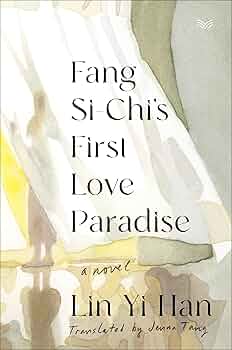
Fang Si-Chi’s First Love Paradise, written in Traditional Chinese by Taiwanese author Lin Yi-Han and translated into English by Jenna Tang, is an intense and uncomfortable read.
The story is full of pain and trauma, and is said to be of an autobiographical nature. Yet it is also full of love and beauty.
Widely recognised as the most influential book of Taiwan’s #MeToo movement, the story can be summarised in one “direct and brutal” sentence, as Lin described in an interview eight days before her death by suicide at the age of 26 in 2017:
“Over many years, a teacher used the power of his position to seduce, rape and sexually abuse female students.”
And that is what happens to 13-year-old Fang Si-Chi, who loves reading and learning, and whose parents are rich and strict yet unsuspecting of all figures of authority. When a revered literature teacher from Si-Chi’s cram school – a type of specialised after-hours school that trains students to pass college entrance exams – offers private tutoring for free, her parents happily accept. After all, he is a long-term resident in their upscale apartment complex.
Si-Chi’s story is a harrowing account of sexual violence and sexual grooming, but it is also a fierce attack at the power structures that allow it to continue happening. One of the most haunting paragraphs in the book is from the teacher and serial predator himself:
“Lee Guo-Hua discovered that there would always be young girls who supported, admired, and loved him. He discovered that social taboos about sex were all too convenient for him. After he raped a girl, the whole world would point at her and tell her that it was her own fault. And then the girl would actually think it was her fault. A sense of guilt would chase her back to him. His sense of guilt was that of a noble, purebred shepherd dog. The little girls were lambs that were forced to run before they even learned to walk properly. Then what was he? He was the most frequented, most inviting cliff for the girls to climb up and jump down from. He could have any girl.”
Equally chilling is the scene when Si-Chi says to her mother “in an innocent tone” that a student in her school is having a relationship with a teacher. Her mother comments: “Already a seductress at such a young age.”
When Cookie, another girl in the story, reveals what Teacher Lee has done to her, she is immediately dumped by her boyfriend: “How can I still be with you when you’ve been dirtied?”
When Hsiao-Chi, yet another girl in the story, tries to expose Teacher Lee online, the following are some of the milder responses she receives: “So how much money did you take from him?” “Homewreckers should go to hell.” “That teacher’s wife should be pitied.”
And when Si-Chi’s dear friend and literary mentor I-Wen gets married, she cannot know that one day her beloved husband will wake up from his drunkenness in a pool of her blood. “He thought about the night before, when he came back home and kicked I-Wen fiercely… The narrow toes of his shoes were like poisonous snakes surging out of him.”
One would ask, how can these girls and women survive such cruelty and continue living? In Si-Chi’s case, her love for literature becomes her only salvation, and she begins to think of her personal hell as her “first love paradise” where even the most vile, twisted kind of love can offer her strength to live. In “A Note from the Translator”, Tang’s discussion of this notion of “paradise” is wroth quoting to some length:
“The idea of sexual grooming…is central to what this novel wants to bring to our attention. It is the idea of a monster trying to make sense of the world for those who didn’t understand what situation they were in, and therefore, through its crooked logic, that monster convinces its audience that certain sentiments, certain emotions, exist for a reason – ones that may be romantic, ones that may bring hope, and ones that those never put under such circumstances may find hard to decipher. For Fang Si-Chi, her grooming became a love paradise, a place that existed only for her, and somewhere she would always be destined to return to. It is not a paradise of love, but a paradise borne of a love for literature that speaks deeply from within her.”
Fang Si-Chi’s First Love Paradise is Lin’s only novel. The author described herself as using a “finely and perhaps overly detailed style” to depict the story, even when she considered “the largest mass murder in human history is the kind of rape that happened to Fang Si-Chi”. There are numerous references to Chinese and Western works of literature – classic and modern, prose and poetry – including but not limited to notions, concepts, quotes, excerpts and passages. As a result, it is understandable and unavoidable that Tang’s English translation is less than 100% faithful.
More importantly, the author confessed that on many occasions she had “deliberately and soberly” misused literary allusions, or used a phrase “not in its most familiar meaning but in its alternative meaning”. In her words: “This is because the story’s protagonist, Fang Si-Chi, is devoted to literature but still at the stage of gobbling it up without understanding everything.” The author immediately continued: “That cannot be separated from how the author writes the story”, which is to explore how art can be dishonest and disingenuous. “[Teacher Lee] wasn’t in love with Cookie, Hsiao-Chi, Si-Chi or any of the young girls. He was in love with his lectures, with that verbal context. He was in love with the setting, that image. Through Lee, the question I put forth is this: Can art consist of fine words that are insincere? Could it be that art was always just insincere words?”
The following reflection from the author is crucial:
“My aesthetics is that form cannot be separated from content. Or, to borrow from Andre Gide, representation cannot be separated from existence. Note that he refers to content as existence… When I was writing this novel, I despised myself a little. The people who survived concentration camps, when they write, it is often with a wish for nothing like it to ever happen again in human history. But as I wrote, I was certain that in the world and in Taiwan, the kind of rape that happened to Fang Si-Chi will keep happening. Right now, at this very moment, it is happening. As I wrote I hated myself a little bit and felt disgraced. I feel that my writing was the writing of disgrace, and I refer to disgrace in the sense that J.M. Coetzee uses it. To speak through the words of Si-Chi [and] I-Wen, this kind of writing is vulgar and un-elegant… This is the kind of writing that you know is no good and yet must still be doing, because it is impossible to represent such massive violence… I often tell readers, when you feel pain as you read, that is real. But now I want to say, when you feel beauty as you read, that is also real. The very real pain that you feel is constructed entirely with words and rhetoric.”
The novel explores the nature of sexual grooming and exposes the sort of false rhetorics and aesthetics that Teacher Lee and those like him use to rationalise their behaviours and to excuse and forgive themselves as “ordinary” human beings. As the author questioned in the aforementioned interview: “How can someone who truly believe in Chinese literature betray this vast literary context and tradition that is five thousand years old?” Yet, as a reader and writer who is truly devoted to literature, the author must have recognised the paradox that as much as she needed to write this novel – “the story [that] has tormented me and destroyed my life” – it is impossible to represent “such massive violence” even with all the worlds in the world throughout the human history. Worse, even when readers can feel the pain as well as the beauty of literature that she herself had once experienced, it is “constructed entirely with words and rhetoric”. So, if the author equated content with existence as she believed was Gide’s insight, then one’s existence cannot and should not be constructed in the way that content is, particularly if that construction is artistic and therefore face the risk of being or becoming insincere, dishonest and disingenuous. This could be the reason why Fang Si-Chi lost her sanity in the story – but could it be enough reason for one to end their own life?
As the author reflected: “My whole novel, from Lee Kuo-Hua to the act of writing itself, it’s all a giant paradox. A questioning of the so-called truth, goodness and beauty of art. I would like to end with a sentence from the novel. As [Si-Chi’s best friend] Yi-Ting looked back at the story that took place in her building, she has an internal monologue: ‘Suddenly she realised that they had been betrayed not by the people who study literature, but by literature itself.’” Indeed, the author’s is a gifted voice gone too soon. Like Fang Si-Chi: “Her life had been snatched away, destroyed, became crooked. She had been led astray.”
Further Reading:
- Interview with Lin Yi-Han (introduction in Traditional Chinese), Readmoo, May 5, 2017.
- “The Landscape Has No Doors”, Jenna Tang’s English translation of “You should get a checkup at a psychiatric hospital”, one of Lin Yi-Han’s last published nonfiction pieces in Traditional Chinese (last edited April 5, 2017, via Facebook), Paris Review, January 4, 2024. Note: This is not a complete translation, having left out the first paragraph and the last two paragraphs of the original text.
- “Once Upon a Time”, Jenna Tang’s essay and English translation of Lin Yi-Han’s short story in Traditional Chinese, as part of Transpacific Literary Project, Asian American Writers’ Workshop, March 27, 2024.
- “Love of Stone”, Jenna Tang’s notes and English translation of Lin Yi-Han’s short story in Traditional Chinese, World Literature Today, November 2022. Note the Editor’s Note: “This text, believed to be the final piece that Lin wrote, was submitted to the editor of [Taiwan’s] INK magazine on April 26, 2017, one day before her passing.”
- “Literary Catharsis: Jenna Tang on Translating Lin Yi-Han’s Only Novel Fang Si-Chi’s First Love Paradise” by Jenna Tang, Literary Hub, May 30, 2024.
Note: There are six other short segments of this interview on YouTube, which have no English close captions. If you are interested in my attempted English translation of their transcripts, please leave a comment below and I will get back to you. Thanks.
Note 2: A shorter version of this book review was published under the title “A life led astray” by Ranges Trader Star Mail, November 26, 2024, P.18. It can also be viewed on the newspaper’s website here.
 Voices under the Sun 陽光下的聲音