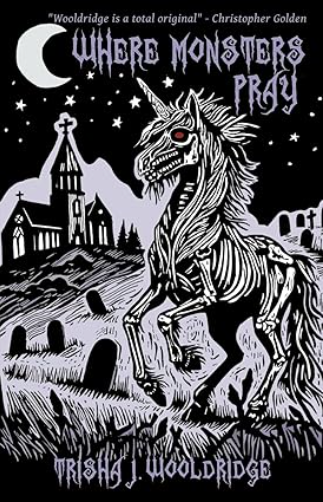
Where Monsters Pray, by self-proclaimed “chaos word witch” Trisha J. Wooldridge, is a collection of sixteen pieces of wonderful, wicked and weird speculative writing. Sixteen, because the first piece “Content Warning” is not a statement alerting readers of potentially disturbing content in the book. Instead, as the author reminds us: “Put down the book, leave the theatre, adjust the settings of your electronic device. Close your eyes. The content is still there. This work of horror is life.” Like it or not, life is indeed a work of horror.
In her stories and poems across the horror, fantasy and sci-fi genres, the author draws our attention to those misunderstood and marginalized, those damaged and downtrodden, those accused, abused and abandoned, those vulnerable and violated, and those forbidden and forgotten. Those who bear the brunt of the dark side of humanity, named “monsters” because they are unfairly and unjustly judged as having deviated from the commonly accepted “norms”, their dignity denied, their status and rights ignored, their existence barely tolerated in the name of political correctness.
The short stories feature protagonists with authentic and distinct voices and impressively diverse backgrounds. “The Mass of the Greatest Sin”, for example, employs horror elements to vividly illustrate the fierce determination of those undermined, overlooked and sidelined to fight for their rightful place in society. A similar theme is shared by “Fixed” and “Heart of Frankenstein”, which enlist sci-fi tropes. The former offers a highly satisfying ending, while the latter is heart-wrenching, its portrayal of the monster’s mate both disturbing and chilling.
Equally impressive is the author’s ability to deconstruct myths and misconceptions, challenging readers to flush their stereotypes down the mental drain while exploring imagined and real futures with brand new eyes. Take “The Last Unicorn Sacrifice in New Hampshire” and “The Unicorn and the Old Woman”, which call into question those stereotypes frequently dumped on the mythical creature. Meanwhile, “Swamp Gas and Faery Lights” and “Turnpike Mary Answers Prayers” delve into the dark despair and dread from which fanciful hopes are the only escape. Then we have “At Least the Chickens Are All Right” and “Gardens of New Bubastis”, which dispute the naïve presumption that humans are the entitled owners and beneficiaries of all on Earth.
And, the poems, which cannot and should not be seen as mere companions to the short stories. Meandering between verse tales and prose poems, their strengths lie in their short form that confronts the difficult issues head on, while unflinchingly exposing readers to the cruel, ugly reality hidden behind the facade of pleasant normality. Just as “Better Horrors and Gardens” explains: “Whispers weave security for actual monsters, / within their hunting ground of HOA-perfect homes – / all full of decoratively shattered mirrors / reflecting the illusion of control.”
Where Monsters Pray marks the author’s achievement in “bleed the things / others dare not say, not think, not do” and “exorcise lust, pain, fear of death, / lush for death, / and all that’s taboo”. Highly recommended.
Note: Where Monsters Pray was published by Pink Narcissus Press, “a small press publisher founded in 2010 that specializes in speculative fiction with an LGBTQ+ and feminist slant” according to its website. The editor-in-chief is Michael Takeda, himself a speculative fiction author and an illustrator. Takeda is the creator of the brilliant cover and illustrations of Where Monsters Pray. You can see more of his art via Instagram (@theoctoporium).
 Voices under the Sun 陽光下的聲音